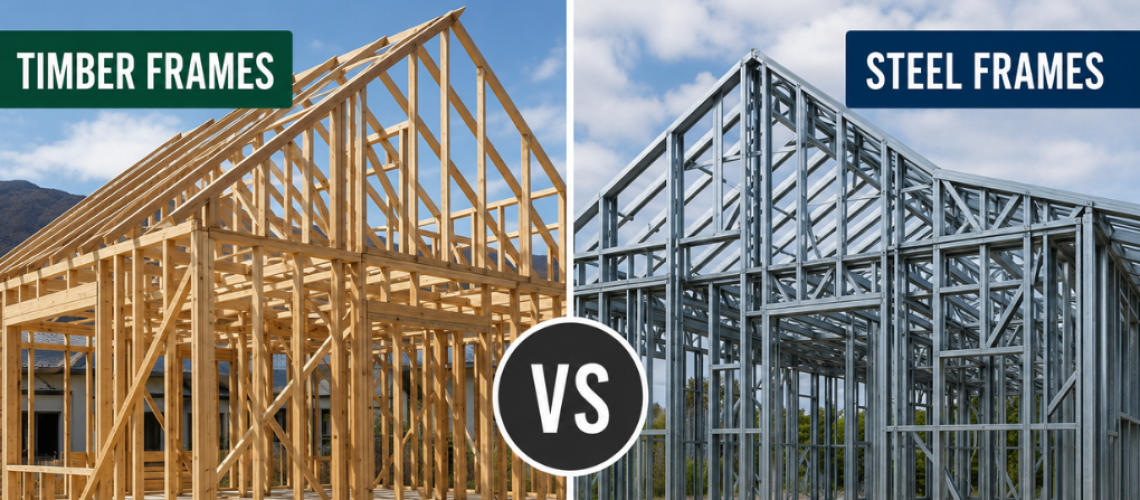
Choosing the right structural frame is one of the most important decisions when building a home or commercial structure. Both timber and steel framing systems are widely used in modern construction, and each offers unique advantages depending on the design, location, and budget of the project.
Understanding timber vs steel frames can help homeowners, builders, and developers make a well-informed decision that balances durability, cost, and performance.
In coastal areas like Hermanus and throughout the Western Cape, the choice between timber and steel frames can also be influenced by climate conditions, local building regulations, and construction timelines.
Therefore, comparing the strengths and limitations of each option is essential before committing to a building method.
In this guide, we explore the pros and cons of timber vs steel frames, explain how local building codes influence material selection, and examine real-world examples where each system works best.
Understanding Structural Framing Systems
A structural frame forms the skeleton of a building. It supports the roof, floors, walls, and overall load of the structure.
Traditionally, timber framing has been widely used in residential construction, while steel frames have gained popularity due to their strength and precision.
Both materials can produce safe, durable buildings when properly designed and installed.
However, the differences between timber vs steel frames often come down to structural performance, construction costs, environmental conditions, and long-term maintenance.
Pros and Cons of Timber Frames
Timber has been used in construction for centuries and remains a popular option for residential homes.
Advantages of Timber Frames
Cost-effective material
Timber framing is generally less expensive than steel, particularly for smaller residential projects.
The material is widely available, and labour costs are often lower because many builders are familiar with timber construction.
Easy to work with
Timber can be cut, shaped, and adjusted easily on-site. As a result, builders can make modifications during construction without specialised equipment.
Natural insulation properties
Timber naturally resists heat transfer, which improves energy efficiency. Consequently, homes built with timber frames often maintain more stable indoor temperatures.
Sustainability
When sourced from responsibly managed forests, timber is a renewable building material with a relatively low carbon footprint.
Disadvantages of Timber Frames
Moisture sensitivity
Timber can absorb moisture, which may lead to swelling, warping, or rot if not properly treated and protected.
Termite risk
In certain areas, timber structures must be treated to prevent termite damage.
Fire considerations
Although timber can be treated with fire retardants, it remains more vulnerable to fire compared to steel.
Pros and Cons of Steel Frames
Steel framing has become increasingly popular in both residential and commercial construction because of its strength and structural reliability.
Advantages of Steel Frames
Exceptional strength
Steel is significantly stronger than timber by weight. As a result, steel frames can support larger spans and more complex architectural designs.
Resistance to pests
Unlike timber, steel is not susceptible to termites or other insects.
Dimensional stability
Steel does not warp, shrink, or expand due to moisture changes. Therefore, steel-framed buildings often maintain structural alignment more effectively over time.
Fire resistance
Steel does not burn, which provides a safety advantage in certain building environments.
Disadvantages of Steel Frames
Higher initial cost
Steel framing materials and installation can be more expensive than timber in many residential projects.
Thermal conductivity
Steel conducts heat more readily than timber. Without proper insulation, this can reduce energy efficiency.
Specialised labour requirements
Steel framing often requires trained installers and specialised tools, which can increase labour costs.
Climate Response: Timber vs Steel Frames
Climate conditions play an important role when choosing between timber vs steel frames.
Timber in Coastal Environments
Timber performs well in many environments but must be properly treated and sealed in coastal areas like Hermanus where humidity and salt air are present.
Benefits include:
- Natural insulation against temperature changes
- Flexibility that allows slight structural movement during strong winds
However, regular maintenance and protective coatings are essential to prevent moisture damage.
Steel in Coastal Environments
Steel frames offer excellent resistance to pests and structural movement. However, coastal air contains salt, which can accelerate corrosion if steel is not properly protected.
Therefore, galvanised or coated steel framing systems are recommended in coastal construction.
When properly protected, steel frames can perform extremely well in harsh environmental conditions.
Local Building Codes and Regulations
In South Africa, building construction must comply with the National Building Regulations (SANS 10400).
These regulations ensure that all structures meet safety, durability, and energy-efficiency standards.
Key Considerations in Building Codes
Regardless of whether timber or steel is used, structural frames must meet requirements for:
- Load-bearing capacity
- Fire safety standards
- Energy efficiency compliance
- Moisture protection
Both timber vs steel frames can meet these regulations when designed and installed correctly.
Professional engineers or architects typically specify the appropriate framing system based on structural calculations and project requirements.
Case Examples: When Each Frame Type Works Best
Understanding practical examples can help clarify the differences between timber vs steel frames.
Example 1: Residential Family Home
A standard residential home in Hermanus may benefit from timber framing because it offers:
- Lower construction costs
- Faster on-site adjustments
- Strong thermal insulation
In this situation, timber frames often provide an economical and practical solution.
Example 2: Modern Architectural Home
For homes with large open spaces or wide roof spans, steel framing may be the better option.
Steel frames allow architects to design:
- Larger window openings
- Minimal interior support columns
- Modern architectural features
Therefore, steel frames are often chosen for contemporary designs.
Example 3: Commercial Buildings
Commercial buildings frequently use steel frames because they require:
- Greater structural strength
- Larger open areas
- Longer spans without support walls
In these cases, steel frames provide the necessary structural reliability.
Cost Comparison: Timber vs Steel Frames
While costs vary depending on project size and material availability, general comparisons can be made.
Timber Frames
- Lower material cost
- Faster installation
- Reduced labour expenses
Steel Frames
- Higher material cost
- Increased installation precision
- Lower long-term structural movement
Ultimately, the decision often depends on the project budget and design complexity.
Choosing the Right Frame for Your Project
When deciding between timber vs steel frames, several factors should be considered.
Important Questions to Ask
- What is the total project budget?
- What architectural design is required?
- How will the local climate affect materials?
- What maintenance requirements are acceptable?
Discussing these factors with builders and suppliers can help determine the most suitable framing system.
Structural Building Supplies at Build it Hermanus
At Build it Hermanus, homeowners, builders, and contractors can find a wide selection of structural building materials suited to local construction projects.
Our store offers:
- Structural timber for framing and roofing
- Fasteners, brackets, and structural connectors
- Protective coatings and wood treatments
- Building supplies suited for coastal conditions
Our experienced team can also provide guidance on selecting the right materials for residential and commercial construction.
Timber vs Steel Frames
The debate between timber vs steel frames ultimately depends on the specific needs of the project.
Timber frames offer affordability, natural insulation, and ease of construction, making them ideal for many residential homes.
Steel frames, on the other hand, provide exceptional strength, durability, and design flexibility, which makes them suitable for modern architectural designs and larger structures.
By understanding the advantages and limitations of both materials, builders and homeowners can make informed decisions that balance cost, performance, and longevity.
For expert advice and high-quality building supplies, visit Build it Hermanus, where our team can help you choose the right materials for your next building project.